Color Me a Kidlit Writer
  • About Me
  • Mama's Chicken & Dumplings
  • Reviews
  • Other Books & Stuff
  • Magazine Work
  • Work-For-Hire Books
  • School Visits
  • Events
  • Interviews, Blog Parties & More

BLOG PARTY! Meet Kelly's KidLit Crew Member

10/2/2021

0 Comments


Callie C. Miller


Picture

Kidlit Member
​of
Kelly's Crew 


Greetings, Callie! So glad you could join in on Day Two of my kidlit celebration!

I love a good party, Dionna!

Me too! Do tell. How did you find your way into becoming a kidlit author and why do you love it?

Even as a kid, I was always writing stories. In college every creative project I did ended up being written for children, and when I realized the Vermont College of Fine Arts offered an MFA program in Writing for Children and Young Adults, I was off to the races! I write picture books through middle grade, and love that kids in those age demographics are still so ready to believe in magic and to embrace the impossible.
 
"Embrace the impossible." Love that! What project of the heart are you working on?

I’m working on a couple of silly picture books, and a new middle grade fantasy (I have a never ending list of upcoming projects). I’m also developing some fun animation projects.
 
What do you love about working with Kelly Dyksterhouse of Raven Quill Literary?

I love everything about working with Kelly! She loves her authors and their work, and LOVES being an agent. She's also so incredibly smart when it comes to editing a manuscript. She's a very editorial agent, and her suggestions always elevate my vision for what I'm writing and make the story stronger. 

Kelly's editorial skills certainly do rock kidlit socks! Thanks so much for participating in my blog party!

Happy to be here!

Picture
​Callie C. Miller is an animation and children's book writer. A lifelong purveyor of words, she delights in the quirky, and is a sucker for black sheep stories. Callie wrote a Star Wars fanfiction novel when she was thirteen, and loves high fives and toast. Callie received her MFA in Writing for Children and Young Adults from the Vermont College of Fine Arts and has twice placed in the Katherine Paterson Prize competition for her middle grade science fiction and fantasy works. Her animation credits include LEGO Monkie Kid, Polly Pocket, and several other shows that are still a secret. Callie, online at calliecmiller.com, is rep'd by Kelly Dyksterhouse of Raven Quill Literary.

0 Comments

BLOG PARTY! Meet Kelly's KidLit Crew Member

10/1/2021

0 Comments


Amy Harding


Picture

Kidlit Member
of
Kelly's Crew


Salutations, Amy! Thanks for opening up my blog party--Day One of Kidlit Fun!

Happy to be here!

Do tell. How did you find your way into becoming a kidlit author and why do you love it?

 
I love the magical power of a well-told story…the power to bring understanding, compassion, growth, and empowerment to little people and big people. As a very visually-inspired person, I fell in love with the picture books story form as a child and still remembered it’s magical powers in college as I studied the intricates of such works as Shakespeare’s tragedies, the Bhagavad Gita, and T.S. Eliot’s, The Waste Land.

While working in the university library cataloging department, thumbing through new pictures books as they came in, I realized that the themes and emotions of humanity portrayed by those complex works I was studying, could be just as effectively portrayed in picture book form, with the added bonus of beautiful illustrations. I love that these literary story gems are accessible to every age of human. So, when I couldn’t find a grad school literature program that emphasized kidlit (since they didn’t’ exist back then), I have instead spent over twenty years reading and studying stories as I have taught middle school, high school, preschool and every other type of school, as well as at home with my seven children. After sharing many magical story moments with children of all ages (along with plenty of adults), I began to dream of writing my own magical stories.
 
Words certainly do have power! So, what project of the heart are you working on?
 

I started out writing the stories I wanted to read to my own children, but could not find. Since my children have grown up in the military with frequent moves and the burden of their dad’s repeated combat deployments to the Middle East, I searched for books that they could connect with their experiences and emotions in even the slightest ways. There were very few. That is what inspired me to start writing my own stories about military families. After years of honing my writing craft and writing many types of stories (some out on submission now), I am currently returning to working on yet another military family story. 
 
Write what you know, right? What do you love about working with Kelly Dyksterhouse of Raven Quill Literary?
 

Kelly is literally the perfect-fit agent for me. She is professional, kind, forthright, patient, responsive, transparent, and takes a long-term vested interest in her clients. It is so much fun to brainstorm with her as a partner! She has the editing capacity to let me know when a story needs work, the creativity to help me get it to the next level, and often puts as much thought into my submission revisions as I do. She is a great partner. She is thoughtful about strategy, proactive in developing relationships with editors, and most importantly, shares my passion for kidlit. I feel very blessed to work with her.

Thanks so much, Amy, for getting my blog party off to a wonderful start!

Delighted, Dionna!

Picture
​Amy Harding grew up in the middle of a great big family with a book in her hand and a love for the power of sharing stories. With a B.A. in English and a professional certification in Writing for Children, she now creates stories celebrating the value and empowerment of the individual. As a military spouse and mother of a great big family of seven kids, Amy has made her home in every corner (and even island) of the U.S. and has fallen in love with all kinds of people, all kinds of places, and all kinds of stories. She currently calls the Olympic Peninsula of Washington home, where she loves hiking in deep dark woods, kayaking in search of orcas, taste-testing all the best chocolates and watching comedy with her teens. Find Amy on Twitter @a_hharding, on Instagram @amyhansenhardingwrites, and at amyhansenharding.com. Amy is rep'd by Kelly Dyksterhouse of The Tobias Literary Agency.

0 Comments

Lions & Cheetahs & Rhinos! OH MY! Launch Party Day Two!

8/16/2020

3 Comments

 
Picture
(c) Sleeping Bear Press, 2020

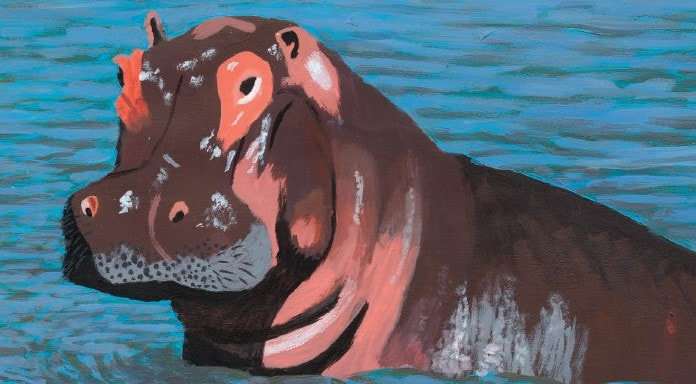
Animal artwork by Yohani from Tanzania


OH MY! Kidlit Author:
​Moira Rose Donohue

Picture

When you first met John Platt while visiting Tanzania, Africa, at the Rift Valley Children’s Village where he teaches children art and where you daughter was working, why did you decide to join him in writing LIONS & CHEETAHS & RHINOS! OH MY!

When I first met John, I wanted to sit in on one of his art classes to see how he taught children to draw and paint. I was so impressed. As we began to talk about our work (I think I was working on a book about the rainforest for National Geographic at the time), we found we shared a creative vision and appreciated each other’s processes. And we shared some unusual overlapping interests as well. I discovered that John had a playlist with big band music that I could use to teach the children how to tap dance!

We didn’t know what we might create together, but before we said goodbye, we promised to give some thought to a joint project. As I reflected upon my time with John, I came to appreciate more fully this young, talented man who was donating his talent as an art teacher, as well as his time every summer, to teach painting and drawing to children in east Africa. I knew we had to do something to highlight their art.

When deciding on the format to tell this informational nonfiction picture book, why did you both decide on focusing on using the phrase “if you want to draw a lion…”?

​My recollection is that, like most creative things, the idea to use that phrase just came to both of us from some creative force in the universe. When we started seriously bouncing ideas back and forth, it stuck. Even though I don’t usually write in second person, it seemed like the right approach for this book—I hope readers agree!

Picture
Picture
Picture
Picture

When you saw the artwork for the book created by children living in sub-Saharan Africa, how did it make you feel?

Not being an artist, I am in awe of anyone who can paint or draw something recognizable! But when I first saw this artwork, I was stunned by its beauty. It fills your eyes with vibrant color and depicts such gorgeous creatures. And it reminds us all that art has no boundaries, geographic, or otherwise--it is for everyone. 

I agree! Why did you decide to donate your portion of the proceeds of this book to John’s nonprofit, How to Draw a Lion?

Actually, we are donating all of our proceeds to the nonprofit. We are both committed to continuing John’s teaching every summer in several African countries because it helps children who would not otherwise be exposed to his art lessons. Naturally, airfare and lodging for three months is expensive and John has been spending his own money to provide this creative outlet. But he can return year after year if some of his expenses are covered through the donations to drawalion.com. Further, the children can continue receiving their art education.

Why do you hope children here in the United States will read LIONS & CHEETAHS & RHINOS! OH MY!?

I hope they will see the incredible artwork that children who live far away from them have created--especially children from different cultures with different lifestyles. And I hope they will be inspired to make art of their own. In addition, as an animal lover who has written a number of books about animals and who has been lucky enough to go on several safaris, I want children here to get learn something about the amazing animals that live on the African continent. 

Picture
Moira Rose Donohue is the award-winning author of over 30 books for children, mostly nonfiction. She began writing for children after her defection from the practice of banking law. She has published several books with National Geographic, including  LITTLE KIDS FIRST BIG BOOK ABOUT THE RAIN FOREST. Her book GREAT WHITE SHARKS is a Junior Library Guild Selection, and her fictional books about punctuation marks, ALFIE AND THE PUNCTUATION BEE and  PENNY AND THE PUNCTUATION BEE, ​are favorites in the classroom. Moira is a co-regional advisor of the Florida SCBWI. She lives in St. Petersburg, Florida with her dog, Petunia. moirarosedonohue.net


Win a chance to receive a signed copy of this book by leaving a comment anytime during the party's duration!

Picture

Ten African animals, including lions, zebras, giraffes, and elephants, are brought to life in colorful artwork, accompanied by fun nature facts. Written by John Platt and Moira Rose Donohue, each animal portrait is painted by a student from the How to Draw a Lion program. Established in 2018 by New York artist John Platt, How to Draw a Lion is a nonprofit art education program that provides art classes for children in sub-Saharan Africa (Sleeping Bear Press, August 15, 2020).

​A successful combination of factual prose and appealing artwork." 
                                                                                 School Library Journal 

Purchase your copy today


All art used by permission of Sleeping Bear Press.
3 Comments

Lions & Cheetahs & Rhinos! OH MY! Launch Party Day One!

8/15/2020

1 Comment

 
Picture
(C) Sleeping Bear Press, 2020

Animal artwork by Samuel from Kenya

OH MY! Kidlit Author:
John Platt

Picture

How did the idea come to you of using the beautiful, expressive art of African animals painted by children living in sub-Sharan Africa whose talents are revealed while enrolled in your art-education program, How To Draw A Lion? 

I first had the idea of doing a children’s book back in 2016 and started putting art aside for it then, choosing whichever pieces I thought were really strong that the kids had already done. I didn’t want to make the project about the kids doing something specific for the book, but rather shaping the book around the kids’ creativity. 

Why were you excited about the idea of working together with Moira Donohue on the children's book that includes the children's art, LIONS & CHEETAHS & RHINOS! OH MY!, out today from Sleeping Bear Press? 

Moira and I met in 2017 in Tanzania, which was total serendipity because she was already a well-known author and I really love her work, especially Penny and the Punctuation Bee, which is such a fun read but also so educational for kids. She attended one of the art classes and saw all the wonderful wildlife paintings the kids were doing. As it turned out, her forthcoming book was Little Kids First Big Book of the Rainforest with National Geographic and we bonded over our shared love of the hyacinth macaw. I mentioned to her my idea for a children’s book on African animals with the kids’ art and we ran with it. ​
Picture
Picture
Picture
Picture

What was your process as you and Moira worked together--going from idea to manuscript from manuscript to book?

I put together a rough outline and Moira and I carefully edited it together. Navigating children’s book writing is really something to do with a professional and Moira’s understanding of prose, structure and editing really shaped the book into what it is today.  Moreover she gave the manuscript to her agent who found us a publisher so it really wouldn’t have happened without her, and I am so grateful!  

Why did you decide to donate your share of the book's profits to How to Draw a Lion?
   
It was easy for us to make the decision that all proceeds should go back to the kids through How to Draw a Lion. The focus of the program is really about creative opportunities for youth and we weren’t interested in taking any of the potential revenue stream for ourselves.
​
That's wonderful, John! How did you feel when you saw the final book?

I was blown away by the book when I first saw it. Felicia, the book's designer, did such an amazing job and I cant wait for others to see it as well!  I hope that kids feel inspired to create their own works of art, not just of animals, but to understand there is a whole world in visual art waiting to be discovered!
Picture
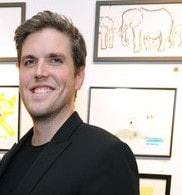
John Platt is a New York-based artist and founder of How to Draw A Lion, a program providing art classes for children, raising money for their education and creating awareness about child welfare and conservation. The program has taken shape around art classes in several sub-Saharan African nations and the U.S. With an extremely low overhead, no offices and no administrative costs, How to Draw A Lion is a sustainable model of art education and fundraising. Additionally, the How to Draw A Lion student-teacher program allows former students to become educators in their own communities year round. To learn more about this nonprofit, visit drawalion.com. To learn more about John, the artist, visit JohnPlattStudio.com.


Win a chance to receive a signed copy of this book by leaving a comment anytime during the party's duration!
Picture

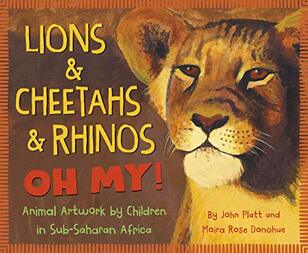
Ten African animals, including lions, zebras, giraffes, and elephants, are brought to life in colorful artwork, accompanied by fun nature facts. Written by John Platt and Moira Rose Donohue, each animal portrait is painted by a student from the How to Draw a Lion program. Established in 2018 by New York artist John Platt, How to Draw a Lion is a nonprofit art education program that provides art classes for children in sub-Saharan Africa (Sleeping Bear Press, August 15, 2020). 

A successful combination of factual prose and appealing artwork." 
                                                                                 School Library Journal 

Purchase your copy today


All art used by permission from Sleeping Bear Press.
1 Comment

Welcoming Jen Malia, TOO STICKY Author

5/3/2020

0 Comments

 
Picture
Inside illustration from TOO STICKY (Albert Whitman & Co., 2020) (C) Joanne Lew-Vriethoff

PictureFind Jen at jenmalia.com and on Twitter @jenmaliabooks.
So happy to have you, here on my blog, Jen!

Thanks for inviting me, Dionna!

First question for you. How did you find your way to becoming a picture-book writer?

As a selectively mute child, I preferred reading and writing to speaking, so it was natural for me to become a writer. My interest in books led me to get a doctorate in English and to become a tenured English professor at Norfolk State University. When I was diagnosed with autism spectrum disorder in my late thirties, my writing became a mission to advocate for the autistic community. I began to write essays for publications like the New York Times and the Washington Post.

In 2017, one of my online writer friends, Rina Mae Acosta, introduced me to an illustrator, Joanne Lew-Vriethoff, who told editors at Albert Whitman about my work. They asked me if I would be interested in writing a picture book about sensory issues with autism. After a few revisions, they made an offer on the book, and Joanne ended up illustrating it! 

That's awesome! What's your debut picture book about?

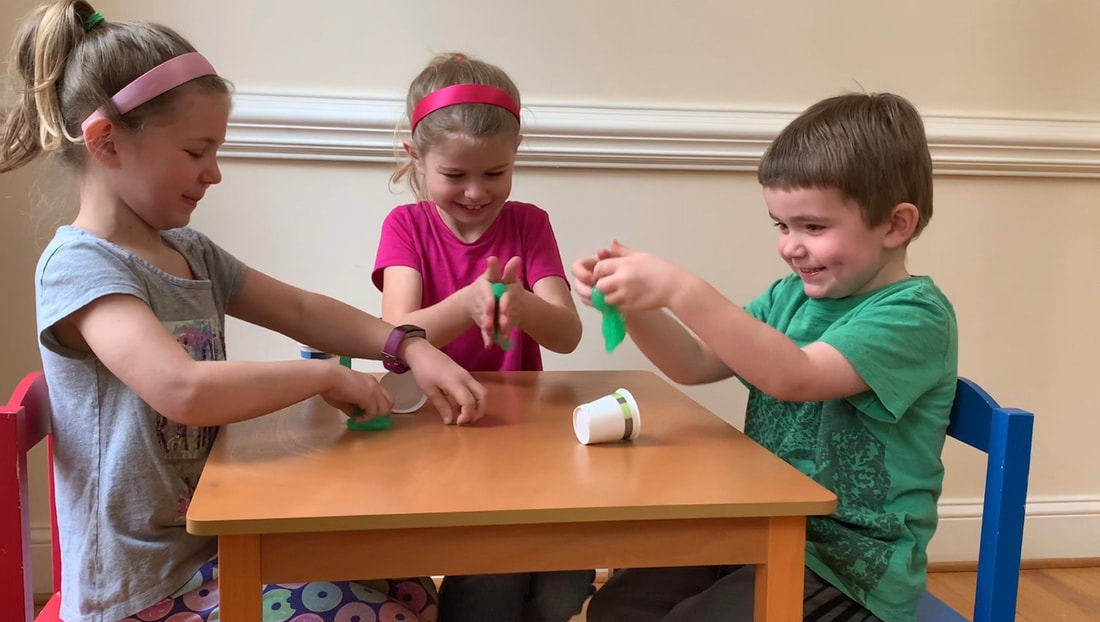
TOO STICKY! SENSORY ISSUES WITH AUTISM is the story of an autistic girl named Holly who has a fear of sticky hands. She’s anxious about slime-day at school. But with the help of her family, teacher, and classmates, Holly gives slime a try. TOO STICKY! is based on my own and my daughter’s experiences living with autism and sensory issues. The fear of sticky hands is actually more of a sensory issue for me than my daughter. My daughter is much more willing to play with slime or playdough than I ever was.

What inspired you to write it?

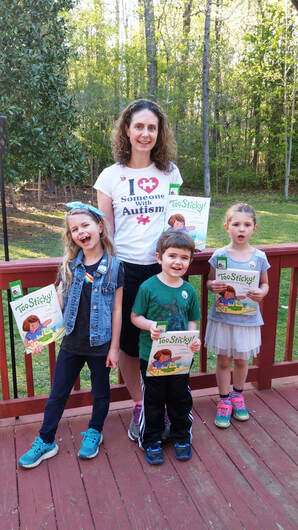
I wrote TOO STICKY! because I wanted my kids to see themselves in a picture book. Most picture books that address autism aren’t written from the point of view of an autistic character. I named three characters in TOO STICKY! after my kids, so they could really picture themselves in the story. Watching them giggle when we read the F&G together for the first time is a moment I will never forget.


Picture
Jen's kids playing with slime.

As you did your research for your book, did you learn something new?

For accuracy, I researched the science of slime. The back matter in TOO STICKY! includes a slime recipe. I had also interviewed autism researchers from around the world, and developed a special interest in the gender differences with autism. According to the Centers for Disease Control and Prevention, for every four boys diagnosed with autism spectrum disorder, only one girl is diagnosed.

An editor at Albert Whitman read my first essay for the New York Times, “What a Muppet with Autism Means to My Family,” which focuses on Sesame Street’s autistic Muppet, Julia.  She then asked me to write TOO STICKY! with an autistic girl as the main character.

In my most recent essay for the New York Times, “My Daughter and I Were Diagnosed with Autism on the Same Day,” I wrote about autistic females who are often overlooked for an autism diagnosis, including me and my daughter. When we were diagnosed, she was two and I was thirty-nine. All of the other children’s books I’ve drafted so far have autistic girls as the main characters to raise awareness and acceptance, especially for autistic females.

Why do you hope children will read your book?

I hope autistic kids will read TOO STICKY! so they see a character that reflects their own life experiences. My book is not a book about autism; it’s a book about a girl who happens to be autistic. She goes about her everyday life. She has pancakes with her family for breakfast. She interacts with her classmates at school. She loves science. But she experiences the world through an autistic lens. Her autism is part of her identity.

I also hope that other kids who read TOO STICKY! will have a better understanding of autism and will be more accepting of differences. Just as preschool kids watching Sesame Street find Julia to be a likable character, I want kids reading TOO STICKY! to root for Holly.

Your book, I know, will be a winner not only with parents and educators of autistic children the world over, but with those kids like Holly who might have a challenge when stickiness gets on their hands. Thanks so much for sharing your journey, Jen! It is truly inspiring.

You are more than welcome. 

Picture
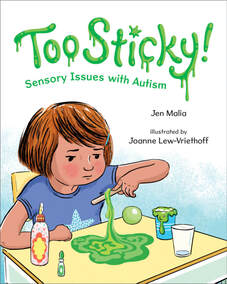
Too Sticky! Sensory Issues with Autism
written by Jen Malia and illustrated by Joanne Lew-Vriethoff is about Holly, who loves doing experiments and learning new things in science class! But when she finds out the next experiment is making slime, she’s worried. Slime is made with glue, and glue is sticky. Holly has sensory issues because of her autism and doesn’t like anything sticky! With help from family and her teacher, Holly receives the accommodations and encouragement she needs to give slime a try.
Released by Albert Whitman & Company, April 2020

                         “Charming, inclusive, and grounded in real-life experiences.” –Kirkus
                                                           Purchase your copy, HERE.

0 Comments

Interviewing Angie Smibert: WFH Pro

12/23/2019

0 Comments

 
Picture
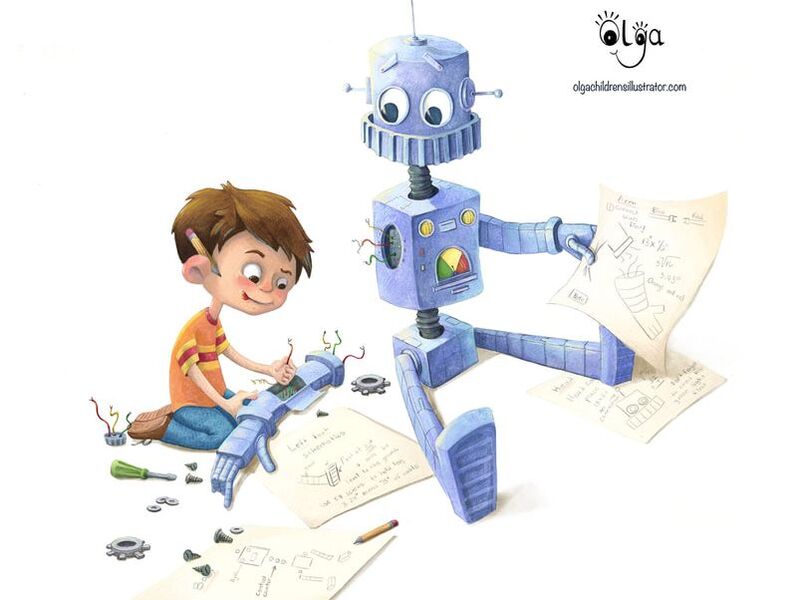
(C) OLGA M. HERRERA, olgachildrensillustrator.com

Welcome, Angie!


Thanks for stopping by!

Happy to be here!

As a work-for-hire (WFH) author for publishers like Abdo and Capstone, you've written nearly thirty nonfiction books, many covering STEM topics like robotics and space travel. How did you come across this kind of work?   

Through my agent(s), I had unsuccessfully tried out for a few fiction WFH projects. Then I discovered the educational WFH market, STEM nonfiction in particular. That seemed a natural fit for me. Before writing fiction (and teaching), I’d been a science writer for over twenty years, working with NASA, the Department of Energy, and the Environmental Protection Agency. 

How would you suggest an author break into educational (or trade) market WFH?

First of all, book packagers and publishers typically have a pool of writers to which they assign books or other projects. Some publishers use packagers or producers. Others work directly with writers. Either way, to get considered for upcoming projects, you need to get yourself into one or more of those pools. You need to find your niche.

How did you find your niche?

My niche wasn’t too hard to figure out. I wrote about space, the environment, and technology for adults for years. Plus, I also did a little coding. So my niche became STEM for elementary and middle school readers. For this age, most of these books are what’s called high interest. Wrapped in glossy covers, high-interest books are chock full of visuals and sidebars. Most include activities, prompts, discussion points, and/or other special features. Often, publishers try to correlate those special features to align with Common Core and/or other standards.

What if STEM is not an author's thing? 

If STEM is not your thing, don’t worry. The educational market spans many, many nonfiction topics, formats, and age ranges. For instance, sports books are huge. (I even wrote a STEM sports book.) So are history, biographies, animals, health and fitness, careers, crafts, and social studies, to name just a few. And publishers need these books at all reading levels, including hi-lo and leveled readers. (Many publishers put out these books in Spanish too.) The most important thing is being able to research a certain topic and then be able to break down the concepts without writing down to young readers.

How might authors find a potential market for their WFH services, even if they don't have an agent?
​
You can find educational publishers and book packagers through a number of resources. Once you find publishers and/or packagers that interest you, study their catalogs, and double-check their websites for submission guidelines for freelancers. You can also check out Molly Blaisdell’s work-for-hire select educational publishers list.

Once you’ve decided who you want to work for and in what areas, you need to send them a cover letter as well as samples of your work. If you don’t have any samples, you may have to write some, depending on the publisher/packager. Some might request a resume instead. Most publishers and producers include freelancer or work-for-hire information on their websites. 
What should authors include in their cover letters, and should they expect a reply?

​The cover letter is really the critical element. In it, describe your experience, areas of expertise, education, publication history, availability, and so forth. Be specific! Don’t just say your expertise is STEM. For instance, I usually say my areas are space, environmental science, computers, and internet technology. Your specific expertise and experience may get you the gig. 

Send out the samples and cover letter—and wait. You may not hear anything until the publisher or packager has a project that fits your skills and interests. This could be a week or two—or many, many months. 

​Do you enjoy doing work-for-hire projects and does it pay well?

I enjoy the work, but to be brutally honest, the pay rates can be very low ($300 for a 500–750-word book, for example) and the turnaround times can be extremely tight (as little as one month!). So you need to be able to research and write quickly and efficiently—not just to meet the deadlines but to also make it worth your time. However, I would say that WFH can be a solid way to fill in pesky income gaps. And I know some WFH authors who do school visits to help generate revenue. But I think you should do WFH only if you love writing about science and technology—or whatever your niche is. 

Thanks again, Angie, for stopping by and for sharing your WFH know-how!

My pleasure, Dionna.

Picture
​Angie Smibert, a Mid-Atlantic SCBWI member, has penned several YA and MG science-fiction and fantasy novels. So far, she’s published twenty-six educational work-for-hire titles. As a science writer for adults, Angie received NASA’s prestigious Silver Snoopy award. Many of her work-for-hire books for younger readers are published within award-winning science series. Angie teaches writing for Indiana University East and for the online MFA program at Southern New Hampshire University. Find her online at angiesmibert.com.

0 Comments

Welcome, Karen Kane, sign-language interpreter by day, children's book author by night (and at all times in between)!

6/30/2019

2 Comments

 
Picture
Salutations, Karen!  So happy to have you here! Please, do tell about your journey to becoming a kidlit author.

Glad to be here, Dionna!

​To answer your question, I’ve always loved to read, but I didn’t start writing books until I had read The Artists Way  by Julia Cameron. Part of The Artist Way program is to free-write three pages a day. You write about anything—how grumpy you feel, what you ate for breakfast, what is annoying you. You just dump. The idea is that by page three you have cleared away enough of your brain clutter to find out what is underneath. And for me what was underneath was the dream of writing a children’s book. The beginning of my manuscript The Hayley Show was started in my morning pages. Although I didn’t sell it, that book got me my agent.

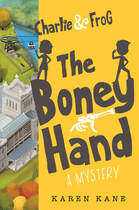
In 2010, I joined SCBWI, which became a wonderful source of support and information. Through SCBWI, I learned about Vermont College of Fine Arts Writing for Children and Young Adults MFA program. And it was at VCFA that I wrote Charlie & Frog. 

Why did you decide to write this story, one that features the Deaf community?

I never planned to write about the Deaf community. I always felt that my writing life and my life as a sign language interpreter were separate entities. But all those years I was interpreting, this story was percolating—I just didn’t know it. One of my advisors at VCFA, A.S. King, wanted me to write something new. She felt I would grow more as a writer with new material. So I began writing short stories. And then one day, while sitting at my computer, this story started to come out of me. And Frog, who is Deaf, came to me clear and strong. Her character was easy to write. 


Picture
(C) ASL-Kids.com

What about your characters and their friendship mirrors your life-experiences?

I tend to be more like Charlie, the quieter one. Frog fights for what she wants and has never met a stranger. Not that being quiet means weakness. Charlie is anything but weak. But Frog helps Charlie find his own strength by modeling her own power and inner drive. That is true for me, too—my closest friends show me how I can embrace my own strengths. Also, as a kid, I had fun exploring with my best friend. I wanted Charlie & Frog to have that same freedom to explore the village of Castle-on-the-Hudson. And who wouldn’t want to ride a gondola across the river on their own? Sign me up!
How did you find a home for Charlie & Frog at Disney-Hyperion and why were you pleased?

When my agent tried to sell The Hayley Show, I had about seventeen rejections (I lost count!), and one editor who was interested, but who couldn’t convince her publishing house to buy it. Ten years later, I was fortunate to have five editors who wanted Charlie and Frog! (Moral: Don’t give up! Keep writing!)

My editor at Disney-Hyperion, Tracey Keevan, is terrific. Tracey happened to watch a documentary about Martha’s Vineyard one week before she received my manuscript. Two hundred years ago, Martha’s Vineyard had a large Deaf population. Both hearing people and Deaf people signed on the island. When looking back, islanders often couldn’t remember who was Deaf and who was hearing because everyone signed. Tracey was excited to work on this story after watching that film. And I was thrilled that Disney-Hyperion hired a Deaf artist, Carlisle Robinson, to illustrate the inside chapter artwork of Charlie & Frog!

What are you working on now, and why are you enjoying it?

I am currently promoting my second Charlie & Frog book--The Boney Hand! It was published in June 2019. I love the characters and setting of Charlie & Frog, so it’s wonderful to be immersed in them again. I am also working on a picture book. Picture books just make me happy. And it’s a nice change of pace from a middle-grade book, as they are so different from each other.

Picture(C) ASL-Kids.com
Karen Kane’s path to Charlie & Frog led her from a small village near Rochester, NY, to the bustle of Washington, DC. The people she met along the way inspired her writing with their warmth and humor, especially those in the Deaf community. Karen graduated from the National Technical Institute for the Deaf and received her MFA in Writing for Children and Young Adults from Vermont College of Fine Arts. When she’s not writing, Karen spends her days as a sign language interpreter at Gallaudet University or lost in the stacks of her local library. Charlie & Frog, her debut novel. was nominated for  a ​2019 Edgar Award Nominated Book in the Best Juvenile category! Find her online at Karen Kane Books.


Picture
Picture

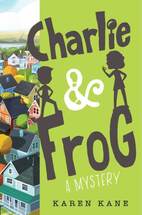
All Charlie Tickler wants is for his parents to listen. All Francine (a.k.a Frog) Castle wants is to be the world’s greatest detective. So begins the friendship of Charlie and Frog, who soon become a crime-solving duo, restoring order to Castle-on-the-Hudson. Click the above covers to order your copy today!


ASL-Kids images used with permission. 
2 Comments

Welcome, Susan VanHecke, copyeditor extraordinaire!

6/13/2019

0 Comments

 
Picture
(C) Christee Curran-Bauer

Salutations, Susan! Thanks so much for stopping by to share with us the ins and outs of what you do as a copyeditor for publishers of books written for younger audiences.

Hi, Dionna! Glad to be here. What do you want to know?

Once an author sells a manuscript, when does a copyeditor step in with his or her red pen?

The minute a contract is signed, an author is welcomed to the editorial process, where the manuscript will be honed and polished to its greatest shining potential, most likely with help from a copyeditor.

But what, exactly, does a copyeditor do? 

Once the author and editor have ironed out the big-picture components of the story—plot and character development, structure, pacing—most likely through a few rounds of revision, the manuscript heads to copyediting. Here the focus on the text goes from wide-angle to close-up. The copyeditor puts the manuscript under the microscope, correcting errors, querying questionable passages, and preparing a style sheet, a record of editorial choices that's used throughout the production process to keep everyone on the same, well, page. 

Through several reads, the copyeditor will scour the manuscript word for word, sussing out errors and inconsistencies. He or she will correct faulty spelling, grammar, punctuation, and usage and ensure consistency in spelling, hyphenation, numerals, fonts, and capitalization. The copyeditor will track continuity of plot, setting, and character, keep on top of chronology, and fact-check people, places, and events for accuracy. He or she may also eliminate wordiness and clichéd writing, smooth out transitions, and revise sentences for flow and readability. 

Picture
(C) Christee Curran-Bauer

WOW! I had no idea a copyeditor did so much! Is there more?

Whenever the copyeditor comes across a confusing or possibly incorrect passage in the manuscript, he or she will flag it with a query. Just like it sounds, the query is the copyeditor’s question to the author on behalf of the reader. If a phrase, sentence, paragraph, or turn of events doesn’t seem to make sense, instead of revising the passage directly, the copyeditor will ask about it in a query, leaving the tweaking up to the author. The helpful copyeditor will often suggest a possible revision in the query.
 
The copyeditor will also format the manuscript to comport with the publisher’s in-house style guide. The style guide is a compilation of editorial preferences specific to that publisher. For example, some publishers like signs, labels, and words on T-shirts to be set in SMALL CAPS. Others prefer ALL CAPS. Or Initial Caps. Or “Initial Caps with Quotation Marks.”

But what if editorial changes are made, and the manuscript evolves?

To keep track of all editorial decisions made while working on a manuscript, the copyeditor will create a style sheet. This document lists character names and info, unusual words not in the dictionary, treatment of words and numbers, story timeline, and other issues specific to the manuscript. This helps all those working with the text at the publishing house—editors, copyeditors, proofreaders—keep things consistent. That way, green-eyed Tasha Clark of 212 Erie Place who turned fifteen on page 6 doesn’t become brown-eyed sixteen-year-old Sasha Clarke of 221 Eerie Court on page 206.

When the copyeditor is finished, the manuscript will be returned to the author's editor, who might add more comments before forwarding it to the author. 

Do authors sometimes get overwhelmed by all the corrections and suggestions?

An author can, understandably, feel overwhelmed by the copyeditor’s corrections and queries. All those marks! My advice to them is don’t freak—the copyeditor’s working in your best interest. However, the book is, of course, the author's—so the author shouldn't think every correction or revision must be accepted. There’s a magic word in copyediting: stet. It means “go back to the original.” The author can override any of the copyeditor’s marks with that simple word (though the editor may disagree and discuss with the author why).

Remember, the copyeditor’s always got the author’s back. Your copyeditor’s mission is to help make the book its absolute best. Once all the issues spotted in copyediting are addressed and resolved, the manuscript will be ready to move to production, continuing its transformation from words tapped out on the computer to that gorgeous book in a reader's hand.  

Authors should feel privileged to have your red pen and sharp copyeditor's mind keeping watch over their manuscripts, Susan! I know I'm honored to have your trusty red pen upon the Highlighter, the newsletter serving the Mid-Atlantic SCBWI, of which I am the content editor!

​How might publishers contact you?


They can find me at SusanVanHeckeEditorial.com, my copyeditor's website and thanks again for having me, Dionna! 

The pleasure's all mine!

Picture
Susan VanHecke is a copyeditor for some of the top publishers in the industy. Writing as Susan Wood, she's also the award-winning children's book author of ESQUIVEL! SPACE-AGE SOUND ARTIST, AMERICAN GOTHIC: THE LIFE OF GRANT WOOD, and ELIZABETH WARREN: NEVERTHELESS, SHE PERSISTED. You can find out more about Susan's books and her red pen at 
SusanWoodBooks, SusanVanHeckeEditorial, and @SusanWoodBooks.


0 Comments

Welcoming kidlit author, public speaker, and double Dutch jumper, Joy Jones!

5/15/2019

0 Comments

 
Picture
(C) Vashti Harrison

Welcome, Joy!


​Congrats about your new release, Fearless Public Speaking! And thanks for stopping by to chat with us about it. 

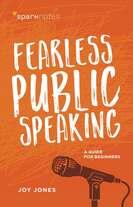
Thanks for having me, and yes, it's exciting! Fearless Public Speaking was just published by SparkNotes, distributed by Sterling Publishing, on May 7, 2019!

What's the book about and why did you decide to write it for young people, ages 12 and up?

Fearless Public Speaking teaches young people how to plan, prepare and deliver a speech with confidence. Outlining, ad-libbing, composing, performing, writing and reciting-- everything you need is found in this fun yet practical guide. I wrote it because many people fear public speaking and a lot of time that fear starts when they’re children. But it doesn’t have to be that way. Actually, I believe that stage fright is your friend--that nervous energy you feel is the power-source that will enable you towards fearless public speaking!

How did you find your home for your book?

SCBWI was the secret ingredient in my success. I had been sending the project out for a long while on my own. But it was when I went to the SCBWI Mid-Atlantic Fall Conference that I had a turn for the better. I met an editor there and initially pitched her a picture book. She didn’t like that book but she said she did like my writing and encouraged me to submit something else. So I did.
What did you enjoy about working with your editor?

My editor was very patient and encouraging. I submitted two books to her before she said yes to Fearless Public Speaking. Although the first two books didn’t appeal to her, she didn’t make me feel like a loser. I felt that I should just keep trying. The third try was the charm!

Why do you hope young people will read it?

Not being afraid to speak in public is a huge advantage. As soon as you get comfortable with standing in front of an audience, you've locked into a powerful personal plus. Besides, if you learn to really enjoy it--it can be a love-and-money combination. To be able to do something you find fun, while boosting yourself professionally, impressing influencers, and even becoming a source of income....it doesn’t get better than that.
      
What are you working on now?

Currently, I’m shopping around a middle-grade novel about a girl who forms a double Dutch team. In real life, I started a double Dutch team--not as a girl but as an adult. In 2018, DC Retro Jumpers did a three-city tour in Russia as cultural ambassadors, teaching and demonstrating double Dutch! Check us out at dcretrojumpers.com.

Picture
Joy Jones has addressed countless audiences-- performance poetry, training workshops, storytelling, classroom teaching. She is the director of the performance poetry group, The Spoken Word and founder of the multigenerational double Dutch team, DC Retro Jumpers. Joy is the author of several books including Private Lessons: A Book of Meditations for Teachers. and Tambourine Moon, which was selected as one of the best books for children by the black caucus of the ALA and featured on the Bernie Mac show. Fearless Public Speaking debuted May 7, 2019. JoyJonesOnline.com


Order your copy of  Fearless Public Speaking today.

Picture
0 Comments

Welcoming Leah Henderson

2/22/2019

0 Comments

 
Picture
(C) Ebony Glenn

Welcome, Leah! Thanks for stopping by!

Nice to be here, Dionna!

Do tell a little about the Kweli conference, and how you found your way onto the planning committee.


Kweli--The Color of Children’s Literature Conference--is a wonderful day-long kidlit writers and illustrators event (with optional Masterclasses on Friday). This year it will be held Saturday, April 6, 2019, at The Graduate Center of the City University of New York. In 2014, after reading author Walter Deans Myers op-ed piece "Where Are the People of Color in Children's Books?", Laura Pegram, editor-and-chief of the Kweli Journal and Kweli conference founder, decided to create an event that is exclusively for Indigenous people and persons of color who were writers and illustrators. As she puts it, “we honor Walter Dean Myers' legacy with a conference that celebrates and supports our voices, our stories, our truth.”

In 2016, I stumbled across a post for an upcoming Kweli conference that was happening that weekend. I didn’t do much thinking, I just sent an email to inquire if walk-ins where permitted and once I got a "yes" back, I booked a train ticket. There was no way I was going to miss it! I had never been to a children’s writing conference where Indigenous and persons of color were the majority. It was a wonderfully refreshing experience to see and hear from creatives who had many of the same concerns as I do. But it wasn’t just about the struggles. Kweli is also a celebration of our many successes. After that first year, I was hooked and about a year later, when Laura asked if I was interested in becoming involved, I was honored to be a part of it all.
​
What do you love about working behind the Kweli scenes, creating a lineup that is both rich culturally and holds promise of a real educational experience for attendees?

I go to a number of conferences and retreats and it’s nice to create programming that I hope to see. Also, I love that Kweli is a good mix of new and established voices. 

Picture
(C) Ebony Glenn

Share one or two of your most memorable experiences while either attending or planning for the conference.

Kweli is a very unique experience. I will never forget the welcome I received during my first conference. It’s hard to explain, but when you are used to being one of the only people of color in a room, it was nice to see and meet so many other POC creatives in one space. They were doing so many amazing things in their work and were just as curious and eager as I was to learn more about craft and the business-side of writing.

May people from any background, not just persons of color, attend the conference?

Kweli is a conference exclusively for Indigenous and POC creatives. It’s an opportunity for this community to come together to speak about issues and concerns that are unique to our experiences as well as general discussions on craft and the ins and outs of publishing. Kweli’s aim is not to exclude, so the organization does offer a literary festival during the summer that is open to anyone interested in attending.

What is the process for a published author or illustrator who would like to be considered for the Kweli faculty?

At the moment, the planning committee creates most of the sessions offered, reaching out to people we feel will work best for each panel or session. Since we want to highlight newer voices on the publishing side of the table as well, we often get recommendations from IPOC editorial assistants, designers, or marketing experts. Everyone, especially Laura, does a pretty good job of knowing which authors and illustrators are coming out with new work that can be highlighted each year.

Picture
Leah Henderson is the author of the middle grade novel One Shadow on the Wall, an Africana Children’s Book Award notable, and a Bank Street Best Book of 2017. Her forthcoming picture books include Together We March, Day For Rememberin’, and Mamie on the Mound. She also has a new middle grade novel  The Magic in Changing Your Stars on the horizon.

Raised in Andover, Massachusetts, Leah has fond memories of getting up to all kinds of shenanigans that often made for great tall tales told late into the night. Growing up in a family of curious travelers, she has always known where there is adventure, there is story. Through seeing the world, Leah has witnessed the richness that can be found within everyone’s individual story. That is why writing the world she sees is so vitally important to her. These days, when she’s not off exploring, you can find her writing, laughing, or playing soccer at midnight with her dog, Boston, in Washington, D.C. Learn more about her and her books at leahhendersonbooks.com.

0 Comments

Meet Kara Reynolds, Query Kombat Host

7/12/2018

0 Comments


Welcome, Kara!

Picture

Thanks oodles for stopping by, Kara, and  many more thanks for choosing my entry GOT ME A DADDY MAP to be on your 2018 Query Kombat team!

I'm happy to be here!

What did you enjoy about hosting the 2018 Query Kombat Kompetition along with Michelle Hauck and Michael Anthony?

I enjoyed the high level of camaraderie between Kontestants. It seemed like a lot of people made connections either through being on the same team or competing against each other. Getting into the contest is exciting for the month or so it goes on, but making connections with other writers can benefit a writer's career for years. To me, that's the real prize of Query Kombat.

I was truly surprised and delighted when my entry was chosen to compete. There were so many excellent entries across multiple genres, including queries and openings from young-adult and adult novelists. Why did you choose my middle-grade entry to be on your team of twenty-one kombatants?

I chose your entry because it absolutely dripped with voice! I think voice is more crucial in middle grade than any other age category. Others may disagree, but for me a strong narrative voice usually is what makes me pull a middle-grade book off the shelf.

How did you feel about someone from your team (yours truly!!!) being crowned 2018 Query Kombat Grand Champion?

Not gonna lie, having someone on my team win felt pretty good! I was just filling in as a host for Laura Heffernan this year, so to be honest, I didn't care too much about winning when we began. But having so many of my entries make it past the first couple rounds helped confirm to me that I do recognize good writing when I see it. Being in the publishing world for several years has helped with that, no question.

Thanks so much for chatting with me here on my blog, Kara! 

Delighted to be here, and congrats again! Don't forget to let me know when you sign with an agent!
Picture
Kara Reynolds writes fiction for young adults, reads books for everyone, and blogs weekly at Operation Awesome. She is a stay-at-home mom with three beautiful children that she enjoys about 90% of the time. (The other 10% is cleaning up messes.) Kara loves Star Wars, Star Trek, Doctor Who, and letting her nerd flag fly whenever possible. Kara’s work is represented by Jill Corcoran of the Jill Corcoran Literary Agency. You can find Kara online at karareynoldswrites.com and on Twitter. To learn more about the Query Kombat contest, click HERE.

0 Comments

Busy-Eyed Day Blog Party: Day 1!

4/10/2018

0 Comments

 
Picture
(C) Frann Preston-Gannon

Welcoming a Busy-Eyed Kidlit Author!
Anne Marie Pace


Picture(C) Julaine Gray
How did you come up with the idea for BUSY-EYED DAY? Did you have any challenges while writing it?

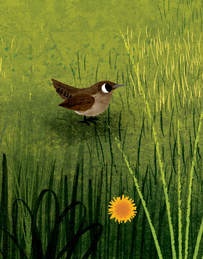
The original idea came from the initial couplet:  Big-eyed bug/Stalk-eyed slug. I seem to remember thinking it up while driving, so I asked my son to write it down for me on a scrap of paper. I had trouble coming up with enough bug-related verses to fill a manuscript, but when I remembered the fun my family had had on a day in Central Park a number of years ago, I was inspired to broaden my thinking about different kinds of eyes into its current incarnation.

How was writing this story different from some of your others?

Well, for one thing, it’s much shorter. I think it’s only about 60 words. For another, it rhymes. I write in rhyme about a quarter of the time, but this is my first published rhymer (another is coming in 2019!). Rhyming books are so much fun to read with kids, and they’re also good for kids learning to read, since the rhyming creates a structure in which kids are more easily able to predict new words.

Do tell about the revision process for BUSY-EYED DAY.

I think I did less revision on this manuscript than I’ve ever done for any of my other books, but there was still some. I didn’t do any for my agent; we sent it out just as I sent it to her.  After Beach Lane acquired the manuscript, there were a few changes, but they were pretty minimal. My editor Andrea Welch wanted me to add a refrain every few stanzas.  And there were small changes throughout.  For example, we talked some about whether girl and squirrel rhyme. They don’t rhyme in every English or American accent, but we decided to stay with it anyway. And there was a couplet that read Bog-eyed frog/Frog-eyed dog which was revised to read Side-eyed frog/Wide-eyed dog because there wasn’t really a bog; the frog is in a pond. The biggest change was the title, which was originally BIG-EYED BUG, but some people felt that promised kids a bug book and it’s not a bug book, so we went with BUSY-EYED DAY, which does keep its promise.

When you first saw Frann’s illustrations, what did you love about them? Did the end result surprise you in a good way?

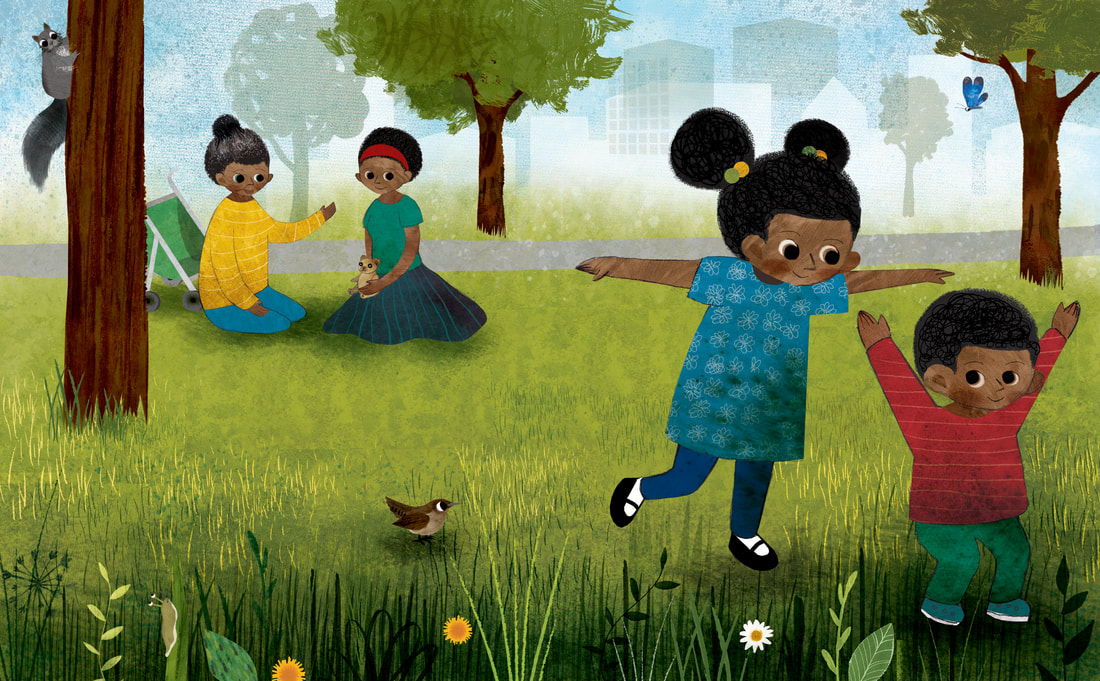
Oh, gosh, this is hard because I’m not good at describing art.  I can tell you that as soon as Andrea mentioned Frann’s name and I looked at her website, I was smitten by her style.  I love the bright natural colors and I love the way she uses brushstrokes for beautiful, interesting effects. My favorite spread in the book is the last one, which takes a bird’s-eye view of the park and we can see all the different people and animals that Sammi and her family have seen during their busy-eyed day.

Why are you excited to see this book in the hands of children? 
​

Getting books into the hands of kids is the whole point and I like to see their reactions when they hear the story and see the illustrations. Hopefully, they will like it and not say, “Read a different one, Mom; this one’s not very good.” But that’s always a risk. (Smile!)


​Anne Marie Pace is a children's book author whose titles  include GROUNDHUG DAY (Disney-Hyperion, 2017, illustrated by Christopher Denise); PIGLOO (Henry Holt, 2016, illustrated by Lorna Hussey); and the published and upcoming books of the VAMPIRINA BALLERINA series (Disney-Hyperion, illustrated by LeUyen Pham), the inspiration for the hit Disney Junior animated series VAMPIRINA. New this spring is BUSY-EYED DAY (Beach Lane Books, illustrated by Frann Preston-Gannon). Find her at annemariepace.com, on Facebook, and on Twitter and Instagram @annemariepace.

Picture
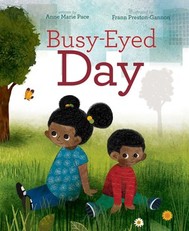
BUSY-EYED DAY is a rhyming and richly illustrated picture book that celebrates the act of being observant and enjoying the magnificence found in the everyday world, perfect for the youngest of readers. It is written by Anne Marie Pace, illustrated by Frann Preston-Gannon, and published by Simon & Schuster, with a release date of April 10. 2018. 
Order your copy of BUSY-EYED DAY from an indie near you.  
​

0 Comments

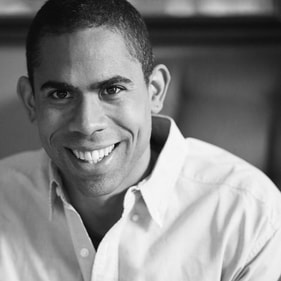
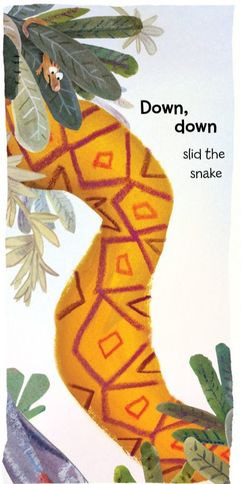
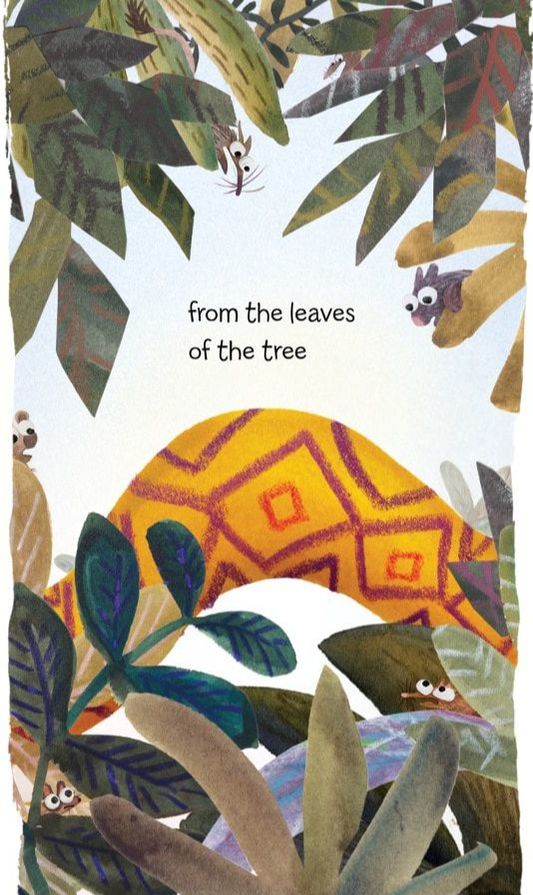
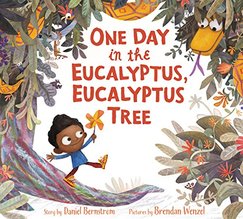
Daniel Bernstrom and His Eucalyptus Tree!

2/22/2018

1 Comment


Interviewing Daniel Bernstrom, Rhythmic Author of
​ONE DAY IN THE EUCALYPTUS, EUCALYPTUS TREE!


Picture
Photo: Austin Hyler Day

Welcome, Daniel!


Picture
(c) Brendan Wenzel
Tell us a little about yourself and how your journey to becoming a children's author
began.


You might say that I began my journey as a picture book writer when I was in first grade. My first-grade teacher had the class do an exercise where we wrote our own story and bound our own book. (My mother still has these little picture books.)

My love of stories and reading intensified in second grade, and I kept telling stories throughout my primary and secondary education: I wrote short stories, plays, and picture books for my little brothers. But it wasn’t until my freshman year in college that I wrote my first novel. I remember an instructor telling me, “You could do this for a living.”

My first novel was a young adult science fiction thriller (this book is buried in some long forgotten desk drawer). In my heart, I thought I was a young adult fiction writer. I wrote four more novels—all unpublished—thinking that I was all cool and trendy. Nothing happened. I didn’t get anywhere. ​

​So, I did what all lost writers do; I applied to graduate school. It was in graduate school, (I received my MFA in Creative Writing from Hamline University) where I realized that I enjoyed writing picture books. I know this is a rather anticlimactic ending, but the moral of the story is to be open to writing anything—even picture books. You never know where your talents may lie.
What inspired you to write ONE DAY IN THE EUCALYPTUS, EUCALYPTUS TREE?

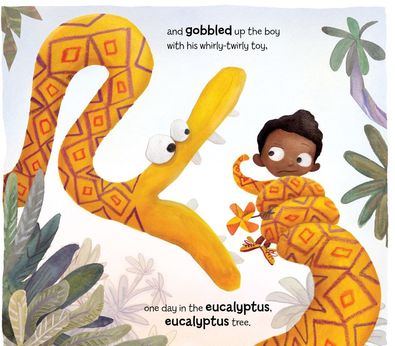
I wrote ONE DAY IN THE EUCALYPTUS, EUCALYPTUS TREE while I was attending graduate school and after I had just gotten back from a trip to Northern California, a coastal land where the eucalyptus tree grows like a weed. In order to help pay the bills, I worked as a janitor at my wife’s preschool. It was during those late hours until 11:00 p.m. and sometimes past midnight that I would make up silly songs to pass the time. As it happened, a silly song bounced around in my head as I was vacuuming up tiny little playground pebbles: “One day in the eucalyptus, eucalyptus tree, hung a scare in the air where no eye could see, when along skipped a boy with a twirly-whirly toy to the shade of the eucalyptus, eucalyptus tree.” And perhaps, as you read that line, you can imagine me moving through the preschool and including into my silly song various, haphazard stuffed animals that were housed on the shelves.
Your book has an incredible sense of rhythm that resonates with kids and is really fun to read aloud. How do you find the "beat" of a story? What inspires your musicality with words?

Writing in rhyme is one of the hardest things ever! Frankly, I feel like an impostor poet, like I don’t write poetry the right way. So please be warned, if you read One Day in the Eucalyptus Tree and expect to find a symphony of words carefully wielded by a master-writer bent over his keyboard, I fear that you will be sorely disappointed, though Dionna disagrees with that assessment.

I was told in graduate school that writing comes from who we are, from the compost pile of our lives. Writers don’t need to be brilliant, they just need to be themselves, and… be kind to themselves. My sense of rhythm came from my ​years of singing. I sang throughout middle school and high school, I sang in college. 
Picture
(c) Brendan Wenzel
I wrote songs. I listened to music. I think you can see the compost heap of musical influences in the syncopated rhythms and near-rhymes in the book. In music composition, you have rhythm and beats and rests and time. But music is fluid and the tempo can change. There are various symbols in music that prompt me, the singer, to crescendo a line or to soften a phrase. I image these symbols as I write picture books. I choose words with certain syllables and stresses to guide the reader’s tongue. I use commas and periods and line breaks like rests in a line of music. I don’t know if this is called poetry, but when I write, I see music. I can’t help it.

What is one of the biggest challenges you face as a children's author, and how do you overcome that challenge?

One of the biggest challenges is finding the strength to try again even when you fail. I fail a bunch. Just ask my editor and my agent. Sometimes I wonder if they'll ever get sick of me and kick me to the curb. I spend months, even years writing a picture book, and when that picture book doesn’t work, there is an amazing sense of loss. Usually, after a manuscript gets rejected, I can’t write for one to two weeks. I’ve learned that this is okay. I’ve learned that the sting of loss is normal. As social scientist Brene Brown admonishes in her book Rising Strong, a loss must be addressed and emotional wounds must be allowed time to heal. Only when we can acknowledge the pain and allow time for healing can we stand up and try again.
Picture
(c) Brendan Wenzel
What children's project are you working on now?

I am working on a bunch of projects. Like a musician playing music to soothe his soul, so I write for the love of writing. My graduate instructor, Phyllis Root, called such a lifestyle of writing “play.” I think of her often when I write. When I had the honor of studying under her at Hamline University, she never told me my writing was crazy or stupid, she just let me play and believed something wonderful would happen in that space between my heart and the page.

​This philosophy is important, because sometimes what I think is awesome isn't, and sometimes what I think is stupid is awesome. The best thing I can do is just write and let the chips fall where they may. I never know when a picture book will pop into my head. I always try to write it down. So, of the five picture books I’m writing now, I don’t know if you’ll see one or all of them. I’ve learned, or, I’ve come to learn that such a process of creativity is okay. Artists can’t stop creating. It’s what we can’t help doing. It’s what I can’t help doing.

Picture
​Daniel Bernstrom is the author of ONE DAY IN THE EUCALYPTUS, EUCALYPTUS, TREE--a rhythmic tale of a sneaky snake that has no idea his bellilicious delights are planning an escape!. Told In the spirit of There Was an Old Lady Who Swallowed a Fly, Daniel's rhythmically delightful text is a perfect read-aloud with gorgeous illustrations by award-winning Brendan Wenzel, published by HarperCollins in 2016. Daniel , a visually impaired author, has two forthcoming picture books being released by Harper Collins sometime in 2018. Daniel currently works as an adjunct instructor at Minnesota State College Southeast where he teaches creative writing, English, and speech. He received his MFA in Writing for Children and Young Adults from Hamline University. Find him at lillylabs.com. 

1 Comment

DAY 1: This Little Piggy Had a Blog Party

6/27/2017

7 Comments

 
Picture

Day 1: Introducing Kidlit Author & Illustrator Cyndi Marko


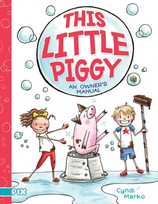
What inspired you to write THIS LITTLE PIGGY: AN OWNER’S MANUAL?

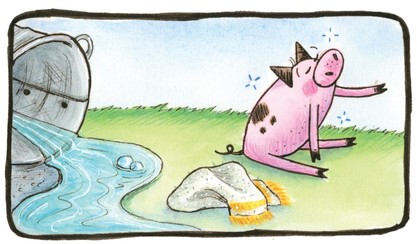
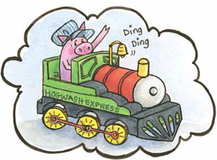
There were a lot of different inspirations for this book as it evolved. The idea first sparked when I found the word “hogwash” funny. I was just minding my own business, doodling on the couch when I heard someone on whatever show my family was watching say “hogwash,” and I got images in my head of kids trying to bathe a pig. The first version of my story was pretty much a long-running (and probably annoying) joke of having to bathe and immediately re-bathe, over and over, a pig named Snowflake. I had originally intended to title my project HOGWASH, but I found a couple of other children’s books with that title. Still, I finished creating the story, and my agent and I submitted it as THE ULTIMATE PIG CARE HANDBOOK. Eventually, it became THIS LITTLE PIGGY: AN OWNER’S MANUAL. 

In your story, Brother and Sister's mother is quite obsessive about her garden, and is not at all keen on them getting a pet pig. Any similar childhood experiences?
 
My own mother was equally obsessive and overly-fond of her garden, so much so that I used to tell her I hated her flowers and didn’t want to have to look at them. She (jokingly, I think) threatened to ground me once if I didn’t come look at her garden, so she partly inspired the mom-character in the book. (Incidentally, she still makes me look at her garden when I visit her, but I don’t mind so much anymore.) 

I also desperately wanted a pet when I was a kid and embarked on a many-years-long campaign of pestering my dad to let me get a puppy. When I turned 15, I changed tactics and my friend Rozz and I conspired. She got me a kitten for my birthday and I begged and made sad faces until my dad gave in and said I could keep him. 

In your illustrations, you chose to depict a blended family. Any particular reason why? 

I wanted to depict a blended family where two single adults with children come together. Brother and Sister are step-siblings, with the emphasis on siblings. There is also a dad in This Little Piggy’s family, he just didn’t make it into the final version, as Mom is the one they ultimately have to convince.

Why did you decide to tell the story using a comic-book style for a format, and was this type of book fun to create?

I think stories aimed at kids who are emerging or struggling readers work really well in a hybrid chapter book/graphic novel format. Speech bubbles help to break up the text into smaller blocks so it’s not as daunting to read. The pictures help them to decode the words and also provide a lot of humor and interest to hold their attention. Aladdin Pix books are part chapter book, part graphic novel, and part picture book. 

Besides, comic books are just cool and even cooler to create. 

As both the writer and the illustrator of this book, please share your process. 

For this story, I wrote the words first, then sketched the illustrations, but I made art notes for myself while writing. More recently, on a new project, I’ve simultaneously written the text and drew rough thumbnail sketches, and that’s been a really fun and productive way for me to work. 

Did you do a lot of research about pigs for this project?

I researched pigs because I wanted to include a few fun facts in the text, but the drawings of Snowflake came from my head with no visual reference. I meant for him to look like a child’s drawing. I also wanted the original version to appear like it was a how-to manual written by kids for other kids. I had painted lined paper, added the characters with a stick-figure feel to them, and doodled all over the pages. But that ended up being a bit busy.

I still drew the kids and Snowflake to be reminiscent of stick figures. And as the narrator of the book, I talk directly to the kids as if advising them on how to care for their pet pig. (Unfortunately, I don't always give them the best advice.)

Picture

What did you love about working with Karen and Laura, your editor and art director, throughout this project?

Karen and Laura are oodles of fun to work with! We had a few conference calls with all three of us to go over the art and text together as the book was developing, and my cheeks hurt from laughing so much. Plus, they are both brilliantly creative and come up with fantastic ideas. I couldn’t be happier with the outcome. 

When revising as per the suggestions of your agent, editor, and art director, what were some of the challenges? But why are you glad you made those changes? 

Adriann is a gifted editorial agent and is always super insightful and sharp. She suggested I cut short the running gag of the never-ending bath, and impose more of a narrative. So I went back to the drawing board, and included other kinds of pig care into the plot. The story ended with the kids doing a great job caring for him, and then presenting Snowflake to mom. (Only the house, garden, and yard are pretty much destroyed.) So Adriann's suggestions allowed me to further explore the family-pet relationship of the kids and Snowflake.

The biggest change I made came from Karen, my editor's, suggestion. After she acquired the project, she wanted me to turn the original story, a picture book, into a chapter book. So I had to start almost from scratch to expand the story. I really love the new version and I’ve recently discovered that a lot of my unpublished picture books really need to be chapter books, too. 

On the design end, Laura, my art director, asked me to redesign sister's look. Originally, Sister was wearing a purple dress with a strawberry on it. Her hair was similar, wavy and flowed horizontally, but it wasn’t pulled back from her face. She also wore big, red-rimmed glasses. Laura thought she looked a bit too granny-ish. She asked me to re-draw Sister wearing shorts like her brother. I  mulled over her suggestion, and opted to dress Sister in clam-diggers, as they were one of my favorite things to wear when I was a kid. I removed Sister's glasses and tied up her hair, and I think she’s absolutely adorable now.

When you received your box of author copies, what did you love about the final product? 

As of this writing, I haven't received my author copies yet, but my lovely and thoughtful editor, Karen Nagel, surprised me with two advance final copies, tied in a pretty red ribbon. I was thrilled! I think Aladdin makes beautiful books. I was giddy over the finishing details: spot gloss on the front and back paper-over-board cover, beautiful red end pages, and high quality interior pages. It’s a chapter book but it’s picture book quality. It will endure many readings and after-reading hugs. (Or am I the only one who hugs their books?) 

What kind of fun activities do you have in store for your book launch and school visits?

I live in a small town in Canada, so I haven’t really planned anything....yet. I did recently visit a school where I gave four presentations. I read from THIS LITTLE PIGGY and we did a few fun activities, including making our own Pet Wish-List, like brother does in the book. I’m pretty shy and get some serious stage fright, so I find in-person and even online visits a bit scary, but I am trying to be more outgoing and social these days. The kids are just too much fun.

What do you hope kids who read this book will carry away with them?

That being yourself is what matters most.

Brother and Sister want to adopt Snowflake as a member of the family. They think Mom will accept Snowflake only if he is well-groomed, eats his veggies, stays out of the compost, and wins a prize at the fair. Snowflake isn’t the perfect pig the kids thought they needed him to be, but they love him anyway, and are determined to keep him. But they have to convince mom. In the end, Snowflake is just being himself (chasing after some pesky crows eating Mom’s garden). He manages to win over Mom. She thinks, like Brother and Sister, that he is SOME pig. 

Oh, and I also hope kids will agree with Snowflake that eating jelly doughnuts is awesome (just not stale ones from the compost)!

Picture(C) Vivid Photography
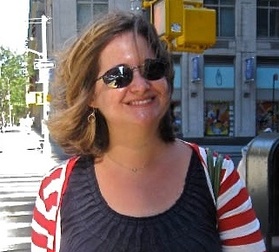
Cyndi Marko is the award-winning author-illustrator of the KUNG POW CHICKEN books, published by Scholastic Branches. Born in Smithers, BC, Canada, Cyndi has fond childhood memories of itchy sweaters, frost bite, and tunneling through deep snow to get to school. As a kid, Cyndi spent most of her time drawing pictures, reading books, making up stories, and never eating too much dessert. Not much has changed, except Cyndi’s mom makes her buy her own crayons now. (Well, most of the time, anyway. Thanks, Mom!) Cyndi currently lives within walking distance of Okanagan Lake in British Columbia, Canada, and hopes to one day meet Ogopogo in person. She has a lot to discuss with him. Her latest work for kids, THIS LITTLE PIGGY: AN OWNER'S MANUAL, was released June 27, 2017 from Aladdin Pix, an imprint of Simon & Schuster. You can find Cindy and her portfolio online at cyndimarko.com. 


Picture

Picture

Click the cover to purchase your copy of  THIS LITTLE PIGGY: AN OWNER"S MANUAL, an Aladdin PIX illustrated chapter book for kids 6-9 that tells the tale of a brother and sister who—more than anything—want a pet pig, written and illustrated by Cyndi Marko, available in paper over board and as an ebook!  

7 Comments

KidLit Interviews!

8/21/2015

9 Comments

 
Picture

Jen Shulmam


Picture
Does being a consultant for children's television and toy companies influence your writing decisions? If so, how? 

While my consulting work doesn't directly influence the specific stories I choose to tell, I think it does help inform my writing.  A big part of my job involves spending a lot of time talking to children about what’s important to them. There's no better way to key in on authentic kid needs, wants, and dialogue than to surround yourself with them!

Although you write for the YA audience, what writing skills, tips, or techniques did you carry over from your years doing research for Sesame Street?

I think the biggest thing I carry with me from my years at Sesame Street is a true respect for children of all ages. There is never a reason to dumb things down for them, whether they be preschoolers or teens. 

Explain how you drew upon your experiences with your Hungarian grandmother while writing your novel Impossibly Perfect.

My Hungarian grandmother--my Omama--was a huge influence on my childhood and even though she passed away fifteen years ago, she remains a regular topic of family conversation as we all strive to live up to her standards. 

She accomplished so much in her life. As a Jewish girl growing up in Hungary in the 1930’s, there were very few educational opportunities. Still, she managed to enter, and eventually be named valedictorian of, an all boys’ Catholic high school. She moved to Prague for medical school and graduated a year early so she could leave before the Nazis closed in. In America, she worked as a successful OB-GYN for over 50 years.

But moving beyond her accomplishments, it was her larger than life personality that inspired me to write about her. She was strikingly beautiful and always dressed like a queen, delivering babies in high heels, full makeup, and jewels. A Hungarian word we often associate with her is “csinos” (pronounced CHI-noshe). It’s the standard of beauty and all-around excellence that she lived by, and expected us to as well. 

Here is a passage from my manuscript IMPOSSIBLY PERFECT, explaining what "csinos" means:

The hairs on the back of my neck stood up straight at that [retracted] word. Csinos. I’d looked it up once in a Hungarian-English dictionary and couldn’t believe it when it said the definition was “pretty.” Pretty! As if that even began to cover it. 

You see, in our family, csinos was the ultimate goal, the impossibly perfect standard.  If you looked csinos, it meant that you looked the best you could ever possibly look in your entire life. It meant that you looked beautiful, tall, thin, young, or old (depending on if you were young trying to look old or old trying to look young). 

It also meant no torn jeans, no underwear showing, no black because I’m too young to wear black, nothing too tight, nothing too baggy, nothing too old, nothing too trendy, nothing wrinkled, nothing that would embarrass Mom or Omama.

Omama was always csinos.

Mom was usually csinos.

I wanted nothing to do with csinos.


How does living in New York City influence your writing?

New York City is a great place for writers, there is so much inspiration everywhere! Just walking down the street you can overhear something that sparks an idea. There are also so many other writers who live here and it’s great to be a part of that community.

How did being nominated for the SCBWI's Sue Alexander Award in 2013 encourage you to keep on writing for young adults?

First of all, I can’t say enough good things about SCBWI. I highly recommend that anyone who writes for kids join and go to events and conferences!  I’ve been going to conferences for about six years now and I can honestly say my life is better for it. I have been inspired, my writing has improved, and I’ve made lifelong friends.

Being nominated for the 2013 Sue Alexander Award was pretty mind-blowing. It validated that even though I’m not published yet (or rather, that I’m pre-published, as they say in SCBWI), I’m on the right track, doing what I’m meant to do. I am so thankful for the boost of confidence that the nomination has given me!
Jen Shulman grew up in Syracuse, New York where she read, and then re-read, everything she could get her hands on. She went on to earn a BA in Communications and English from the University of Pennsylvania and an MA in Communications and Education from Columbia University, Teacher’s College. When she's not writing YA contemporary novels, she work as a consultant for children's television shows and toy companies. Jen started out her career in 1995 at Sesame Street and now consults for many different companies, including Nickelodeon, Disney, and LEGO. She can be found online at jennifershulman.com and Tweeting @jenshulman.


Pamela Ehrenberg


PicturePhoto credit: Erin Silber
Why do you think listening is an indispensable writers' tool?

So many possibilities! Listening to characters—they tell me where the story needs to go. Listening to children—they know so much more than the world gives them credit for. (The best advice I ever received as a parent was never to ask a child a question I already knew the answer to.) Listening to feedback from critique partners and of course from professional critiquers like Carrie Howland, my agent—an essential reality check about how the words on the page compare with the story in my head. Listening in general—because it’s so easy to fall into the habit of describing things only visually, when sounds, smells, tastes, and textures/temperatures can make a scene so much more alive. And listening in coffee shops—because a really nice perk of being a writer is that eavesdropping counts as professional development.

In what way would you say writing is therapeutic?

Oh, I don’t know: “therapeutic” suggests fixing a problem, but for me writing is more often a reminder to accept, even embrace, imperfection. My eighth-grade self is still very much with me most days—which can be challenging at a staff meeting or social event, but writing validates that she’s an essential, and sometimes not totally unlikeable, part of who I am.

I will say that most days at lunchtime, when the weather allows, I bring my laptop outside to Franklin Square, on K Street in DC—and the Vitamin D from the sunshine is definitely therapeutic. I would imagine this would be much harder for someone who works in a different art form, like a harpist or a sculptor.

Why do you think community should play an important part in your characters' journey?

Well, it’s played a huge part in my journey as a writer: undergraduate writing workshops; the 12 x 12 online community where I became brave enough to cross over into picture books; the Children's Book Guild of Washington DC, an invaluable source of friends and mentors; my beloved writing group that evolved to become "family" somewhere in our second decade together . . . and of course SCBWI!

In terms of my characters’ journeys—I’ve always felt that their journeys are theirs to experience, and my job is to convey them as accurately as possible. So while community definitely is part of many of those journeys—Tillmon County Fire is told from multiple characters’ points of view, as the community itself is maybe a character in the novel—but I find that anytime I try telling my characters what “should” be part of their journey, they remind me that they have plans of their own and that my role is to sit down and type.

Why do you think it is important for writers to include a diverse lineup of characters in their books?

Earlier this year, I read Robert Putnam’s book Our Kids—and it’s alarming how, even in the course of a generation, kids are more and more often spending their entire childhoods (neighborhood, school, summer, activities) with kids who, by any demographic measure, are exactly like themselves. Authors and illustrators have a big role to play, because sometimes we may be a kid’s best hope at meeting someone different. What a  responsibility, to remember that the books being written today will shape the worldviews of people who will be leading countries and movements 50 years from now. My (Jewish) 10-year-old feels this need as well: she is currently organizing an effort to convince the American Girl company of the need for a Muslim American Girl book and doll.

So—while I don’t think we can dictate our characters’ journeys, I do think we have a big responsibility to ensure that the stories being written reflect the many, many lives of children today. And we need to keep reminding publishers, booksellers, and the book-buying public that their help is needed to launch these stories out into the world.

PJ Library has been such a wonderful partner to work with in the arena of Jewish children’s books—I so wish that another nonprofit would jump on this idea and begin mailing out free books with other multicultural emphases. What a great way to get publishers to take a chance on titles that might not be obvious bestsellers…I wonder if your blog audience might include any diversity-minded philanthropists who are searching for a next project!

What does "writing with your feet" mean?

When I was a sophomore in college, I skipped a class (felt so rebellious!) to attend a presentation by one of my favorite authors, Bobbie Ann Mason. I arrived early and sat in the front row—then found myself unable to focus on what she was saying, because I kept noticing her shoes: plain canvas sneakers similar to ones that I and almost everyone else I knew wore all the time. I kept imagining her standing in line at a big box store, having her purchase rung up, and paying for her shoes—without the cashier having the slightest idea that this was a super-great and amazing author buying sneakers in his check-out line!!! To that imaginary cashier, Bobbie Ann Mason was just a regular person. And if authors could be regular people—that was my first glimpse that regular people could sometimes maybe be authors. Maybe even—dare I hope for it?—me.

In a row of feet, no one can tell which ones belong to a writer. For me, writing with our feet means embracing the most ordinary parts of ourselves and our experiences—and trusting our voices to convey their humor, interest, and value.
Pamela Ehrenberg is the author of Ethan, Suspended & Tillmon County Fire, both published by  Eerdmans Books for Young Readers; and Planting Parsley, forthcoming from PJ Books. She lives in Washington, DC, with her two favorite young readers and can be found at pamelaehrenberg.com and Tweeting @PamelaEhrenberg. 

9 Comments

KidLit Interview!

8/20/2015

7 Comments

 
Picture

Kathleen Kellett


Picture
When you are imagining the worlds in which your stories take place, where do you start? With a picture? With a historical place? With a phrase?

Before I imagine anything about the worlds, I imagine characters. For all of the stories I'm juggling now, my first entry into the worlds was the image of a single character. All of them have had very distinct aesthetics in terms of clothing, hair, etc., which have immediately placed them in a certain type of world, in the broadest sense (pseudo-historical vs. modern, for example). I can also usually picture the character within a certain type of natural environment, as well, which also greatly informs the world-building. The specific details begin materializing pretty quickly once I have that first character.

Did you have a very active imagination as a child? If so, please share a story where your imagination either served you well or got you into trouble while in school?

I had an extremely active imagination as a child. I was also a total goody-goody, though, so I don't think it ever really got me in trouble. It did often stave off boredom, though. When I was in kindergarten, I had this whole soap opera-esque story that I would revisit every nap time. I don't remember all the details, but I know it involved a tearful deathbed farewell song (because it was also a musical, naturally). I really looked forward to reclining on my little 101 Dalmatians towel and staring at the darkened ceiling while I pondered this Great and Meaningful Tragedy I had created. I'm not sure where all the doom and gloom came from, since I wasn't consuming a whole lot of tragic media at age five--except for The Lion King. Maybe that had just made a really big impression on me!

In your opinion, how important do you think it is for a fantasy writer to have imagination in her tool bag?

I can't think of any way someone could be a fantasy writer without having a big imagination. It's not the only necessary tool: fantasy writers also have to be diligent observers of their own world in order to come up with viable new ones. Every time I come up with a new detail about my fantasy worlds, I have to think of how characters would realistically react to that detail. To do that, I have to draw on my knowledge of how real people act, and then use my imagination to apply that to the made-up situation I've concocted. This is also why it's important for aspiring fantasy writers to listen to and read about experiences that are very unlike their own. I mean, it's important for all people to do that, of course, but all writers should remember that the more you learn, the more you can imagine.

Why do you find sketching your characters and their worlds to be an invaluable step in getting your stories out?

I really enjoy drawing my characters. I have a sketchbook full of pictures of them. I'm not the best artist in the world, but sometimes I manage a decent portrait! Mostly, it's just something I do for fun, but I will occasionally start drawing if I feel stuck. I needed to come up with an idea for a grad school project once, and drawing the first characters that popped into my head helped me unlock a whole story that is now in its second year and sixth draft! For another project, drawing helped me hammer out the details of the end of a trilogy. I think when I'm drawing a character, I'm very focused on them, but I don't feel the pressure of "I have to figure this out right now" because I'm not actively outlining or writing. It's almost like I'm just meditating about who this person is, and that often leads to good ideas about what will happen to them.

Did your AmeriCorp experience inspire any ideas for any new projects? Did it broaden your outlook on life and therefore impact your writing decisions? Please, explain.

I'm still only a little over three months into my AmeriCorps experience, so I don't quite know yet how it will impact my writing yet, but I'm sure that it will. I'm learning a lot of things I never knew before, and I have no doubt that some of this knowledge will trickle into a story one of these days. To be honest, my writing actually informed my decision to do an AmeriCorps term. I write about all these young people who are struggling to make something good and positive happen in their world, even when the odds are stacked against them. I got to a point where I felt like I couldn't just write about people like that--I had to be one of them myself. I feel like I'm in over my head a lot of the time, not gonna lie! But I'm glad that I found an opportunity to help some people in my beloved home state of New Jersey. I hope that someday, when my books are out in the world, they can help people through tough times, too.
Kathleen Kellett is a doctoral student at Rutgers Camden, where she is pursuing her PhD in Childhood Studies. She received her MA in Children's Literature and MFA in Writing for Children from Simmons College. To date, she has written three fantasy manuscripts, two YA and one middle-grade, and is particularly interested in the figure of the monstrous adolescent. She can be found online at kathleenwriting.com and on Twitter under the handle @KathleenWriting.

7 Comments

KidLit Interview!

8/19/2015

3 Comments


Melissa Gorzelanczyk

Picture
Melissa and sisters
Picture
Photo credit: Mark Anderson
What was it like growing up as one of six kids?

I am the oldest (AKA the boss). Growing up with so many siblings meant we were never alone--there was always someone to fight or play with. Quite simply, it was the best. We've remained best friends. 

How does your experience of growing up in such a big family influence your writing?

My books tend to focus on love of all kinds, which is what I felt most in my large family. There were always so many people to love me and in turn, to love back.  

Are any of your characters biographical sketches of people you grew up with?

I'll never tell. *wink 

Have any of your siblings recognized themselves in your work?

I think there's a saying that the people you write about in your books never recognize themselves. That said, I do believe writing tends to be emotionally autobiographical by nature. We write what we know, especially emotions. My siblings aren't in my book, but the emotions we've shared together certainly show up.

How has your family supported your decision to become a full-time writer, and how has that helped you reach your goals?

My husband Shea is the number one supporter of my work and dreams. In fact, he said one of the reasons he wanted to date me was because I was a writer. He's a rare gem, he "gets it", and without him, this journey would have been much harder. 

The rest of my family is supportive, too, but I think all authors would agree that there are few in our lives who truly "get it" and that's okay. 

If the dedication of your book includes your siblings, please share. 

From the acknowledgements: To my sisters and best friends, Crystal, Tasha, Emily and Laura, and my brother Josh, for knowing me since they were born and loving me anyway. (BTW, I’m the boss.)
Melissa Gorzelanczyk is a young adult author who believes love is everything. A dreamer for life, Melissa has been writing books since she was nine years old when she penned her first story about a beloved black horse. She is a member of the SCBWI, The Sweet Sixteens, and the Class of 2K16. She lives in Green Bay with her husband and family. Her debut novel ARROWS is being published by Random House/Delacorte Press, January 5, 2016. She is represented by agent Carrie Howland of Donadio & Olson. She can be found online at MelissaGorzelanczyk.com and on Twitter @MelissaGorzela. 


3 Comments

KidLit Interview!

8/18/2015

7 Comments

 
Picture

Olivia Hinebaugh


Picture Photo credit: Shoot Photo Inc.
How do you juggle being a stay-at-home mom and a writer serious about her craft?

Well, in some ways I always feel like I'm failing at something. Some days I don't write. Some days my kids watch TV. And most days, my house is a mess. But I do place a lot of priority on writing time. It helps keep me sane. If I've gotten a good writing flow going, I never feel awful about the day.

How does your hubby support you in your writing endeavors?

First of all, he takes my dreams seriously. It's always been a matter of "when" with him, not "if." But obviously, I need his help to write. He watches the kids. He forgives me when he walks through the door and I'm at the computer and only realize then that I should have made dinner. And he reads my stuff and tells me I'm awesome. 

When did you first decide you wanted to write for young adults?

I think that writing for young adults is a product of the fact that I started writing when I was a young adult. I wrote for teenage-me and I still do. I took a break and studied playwriting and screenwriting in college. When I took my first stab at a novel, my critique partner was the one to point out that it was young adult. Then I started reading young adult voraciously and fell in love with it!

How do your kids feel about mommy being a writer?

Well, my daughter is still a little young to totally get what I'm doing. (She just turned two.) But she has sat down at the keyboard and mashed at it and informed me she was "working." A proud moment was when my son (who is turning five next month) answered a survey about me for mother's day and when he was asked what I did as a job he said "writing" and when he was asked what I like to do, he said "writing." He wants me to write books he can read. So I've started doing just that. I will say, one of the joys with my son is that he writes books too. He dictates them, we print them out and he illustrates them. I love fostering his imagination.

Do you have any writing friends who are also stay-at-home moms? If so, how do you support each other as writer-moms?

Yes! Thank god! My critique partner and dear friend is also a write-at-home-mom. She's the one who encouraged me to take a stab at writing a book. I was sort of bored being a stay-at-home-mom; I needed some mental stimulation. It was easy enough to do while my son played. And pretty soon, the two of us would get together a few times a week. Our kids are the same ages so they play while we work, or talk publishing, or gossip. It's basically the ideal situation.
Olivia Hinebaugh is a write-at-home-mom with a five-year-old boy and a two-year-old girl. Along with parenting articles, she writes young adult novels. This means a) she writes whenever the kids are sleeping and b) her house is often messy. Some people can do it all. Olivia is not one of those people. Recently she's been writing about: hippies, a teen midwife, a theater prodigy, and night club D.J.s. She's on the fence about the Oxford comma. (Put down your pitchfork!) Olivia can be found online at oliviahinebaugh.com and Tweeting at @OliveJuiceLots. 


7 Comments

KidLit Interview!

8/16/2015

8 Comments

 
Picture

Liza Wiemer


PicturePhoto Credit: Jim Wiemer
What inspired you to write Hello?

It’s actually a pretty cool story. Hello? was born out of frustration. In 2011, I had been working on another novel and it just wasn’t going well. After deleting everything I had written that day, I began to pace my living room floor. It’s not something I do often, but I just couldn’t sit still and I needed a way to focus.

And that’s when a completely new idea hit me. I imagined a grieving girl calling her grandma’s old phone number. I could see how that call would not only change her life, but create a chain reaction, transforming the life of the person she called and those connected to him. I immediately knew that the novel would be set on Washington Island and in Sturgeon Bay, Wisconsin. I knew it would be from multiple points of view. I knew how the story would begin and I had a solid idea on how I wanted it to end. I set the other novel aside and started to write Hello?.

Describe what you enjoyed about working with your editor at Spencer Hill Contemporary?

I loved that we were in sync with each other. If something needed tweaking, we would brainstorm, which led to making the novel so much better. It was inspiring, exciting, and energizing!

How did you grow as a writer as a result of writing this novel?

Without a doubt, Hello? tested me in ways I could never have expected. To be authentic to my characters and their voices, it meant learning new skills, including free verse poetry and screenplay format. It’s not an exaggeration to say that I spent hundreds and hundreds of hours working on their skills.

In addition, making sure that the characters’ stories wove together as seamlessly as possible created unexpected challenges. Just like in real life, each of my characters has his or her own struggles. I needed to show them, show how they impacted their lives and their choices while also exploring the concept of serendipity and the power of hope.

When I went from six characters to five, I had to figure out how to piece the novel back together again, which was particularly difficult because a phone call or text clued the reader into whose chapter came next. Everyone was linked. In the end, solving each puzzle, reweaving the threads together was not only tremendously challenging, but satisfying.

Do you find there is a reoccurring theme in the stories you write? If so, explain. If not, What's Hello?'s theme?

Without a doubt--hope! Each one of us faces challenges. Each of us faces moments of despair. But hope transforms. So hold on!! We find strength in different places. It can come from a stranger or someone we love. It can come through kindness, compassion, friendship, family or through hard work or determination. Sometimes we’re barely holding on. The point is, don’t give up!

 Why do you enjoy writing for the YA audience? 

I had an extremely difficult and challenging childhood, but despite it, I found my place. I found my voice. And I got my HEA! Life will always have ups and downs and downs and ups. I love writing for YA because I care. Because I know how difficult that time of life can be, and finally I know that it can and does get better! It’s the most transformative time of our lives. It’s the foundation for the future. 
Liza Wiemer married the guy who literally swept her off her feet at a Spyro Gyra concert. Their love story can be found on Liza's “About” page. Besides being a die-hard Packer fan, Liza is also a readaholic, a romantic, and a lover of crazy socks and rooftops. Hello? is her debut YA novel. She also has had two adult non-fiction books published, as well as stories and articles in various publications. She's a graduate of UW-Madison with a degree in Education and the mother of two sons. She can be found online at lizawiemer.com and on Twitter @LizaWiemer.

8 Comments
Forward>>

    About Me

    I am a children's book author who loves learning about lesser known individuals shining in the margins of African American history. My debut novel for young readers, Mama's Chicken & Dumplings (Margaret Ferguson Books, 2024), received a starred review from Shelf Awareness and is a Junior Library Guild Gold Selection. I am 
    represented by Kelly Dyksterhouse of The Tobias Literary Agency.


    Copying, reposting, or otherwise republishing anything on this blog without permission is strictly prohibited.

    Picture

    Picture

    Picture

    Picture

    Picture

    Picture

    Picture

    Picture

    Picture

    Picture

    Picture

    Picture

    Archives

    October 2025
    September 2025
    July 2025
    April 2025
    March 2025
    January 2025
    December 2024
    November 2024
    October 2024
    August 2024
    July 2024
    June 2024
    May 2024
    April 2024
    March 2024
    January 2024
    December 2023
    September 2023
    August 2023
    July 2023
    June 2023
    May 2023
    February 2023
    January 2023
    December 2022
    November 2022
    September 2022
    August 2022
    June 2022
    May 2022
    January 2022
    October 2021
    September 2021
    June 2021
    February 2021
    December 2020
    September 2020
    August 2020
    July 2020
    May 2020
    April 2020
    March 2020
    February 2020
    January 2020
    December 2019
    September 2019
    August 2019
    July 2019
    June 2019
    May 2019
    February 2019
    January 2019
    October 2018
    August 2018
    July 2018
    April 2018
    February 2018
    December 2017
    August 2017
    July 2017
    June 2017
    May 2017
    February 2017
    October 2016
    September 2016
    August 2016
    July 2016
    May 2016
    April 2016
    March 2016
    January 2016
    November 2015
    October 2015
    September 2015
    August 2015
    July 2015
    February 2015
    May 2014
    March 2014
    September 2013
    July 2013
    May 2013

    Categories

    All
    1935 Labor Day Hurricane
    1935 Vinegar Hill Charlottesville VA
    2024
    2025
    Abigail Halpin
    A Big Mooncake For Little Star
    Abrams Books For Young Readers
    Adriann Ranta Zurhellen
    African American Business Owners 1930s
    African Art By Children
    Aladdin Pix
    Albert Whitman & Company
    Alexandra S.D. Hinrichs
    Alfred A. Knopf
    Alice Ratterree
    Alvina Ling
    Alyssa Bermudez
    Amanda Vacharat
    Amy Harding
    Amy Lee-Tai
    Andrea Beatriz Arango
    Andrea Brown Literary
    Angela Dominguez
    Angie Arnett
    Angie Miles
    Angie Smibert
    Anna Lapera
    Anna Staniszewski
    Anne Marie Pace
    Anne Moore Armstrong
    Annual Virginia Book Events
    A POEM GROWS INSIDE YOU
    Arrows
    Arthur Levine Books
    Art-Themed Challenges
    Ashley Spires
    Ashley Walker
    Autism Picture Book
    Awards
    Bagram Ibatoulline
    Balzer + Bray
    Barb McNally
    Barb Rosenstock
    Beach Lane Books
    Ben Franklin's Big Splash
    Best Book Of The Year
    BIRD NERD
    Blink YA Books
    Blog Hop
    Blog Parties
    Board Books
    BO AT THE BUZZ
    Book Launch
    Book Launch Parties
    Booklists
    Book Trailers
    Boyds Mills And Kane
    Boyds Mills Press
    BRAVE BALLERINA
    Brenda Woods
    Brian Rock
    Bright Literary Agency
    Brown Books For Young Readers
    Busy Eyed Day
    Busy-Eyed Day
    Calkin's Creek
    Callie C. Miller
    Candlewick Press
    Capstone
    Carina Povarchik
    Caroline McPherson
    Cetologist
    Changes In Publishing
    Charlie & Frog
    Charlottesville Illustrator
    Charlottesville Indie Bookstore
    Charlotteville
    Chronicle Books
    Clarion Books
    C. M. Surrisi
    Colleen Muske
    Colleen Paeff
    Comic Book Creator
    Commerce Street Books
    Confetti Kids
    Content Editor
    Coping Skills School-aged Children
    Copyeditors
    Cover Reveal
    Coyote Moon
    Craft Of Storytelling
    Craft Of Writing
    Crenshaw
    Cricket Magazine Contributor
    Critiquing
    Crossover
    Cyndi Marko
    Cynthia Cliff
    Daniel Bernstrom
    Daniel Nayeri
    Dave Mottram
    Dawn P. Noren
    DC KidLit Events
    Deaf Main Characters
    Deborah Diner
    Deborah Lakritz
    Deborah Prum
    Diana Ma
    Dionna Mann
    Dish Up A Reading Delight
    Disney-Hyperion
    Dolores Andral
    Donna & Libby Farrell
    Don Tate
    Doris Kutschbach
    Ebony Glenn
    Eerdmans Books For Young Readers
    Elliott Smith
    Engaging The Audience
    Erica Perl
    Erin Murphy
    Erin Murphy Literary Agency
    Ethan Suspended
    Eucalyptus Tree
    EVELYN DEL REY IS MOVING AWAY
    Farrar Straus And Giroux
    Fearless Public Speaking
    Feiwel & Friends
    Felicia Macheske
    Fine Art Raven Photographer
    Flashlight Night
    Fort Building Time
    Foundry Literary + Media
    Four Beautiful Picture Book Biographies
    Fran Cannon Slayton
    Frann Preston Gannon
    Frann Preston-Gannon
    Fred Koehler
    From My Notes
    Garvey's Choice
    Getty Publications
    GIFTS OF THE MAGPIE
    Good Illustration Ltd.
    Grace Lin
    Grammar Tip
    Great Nocturnal Book For Kids
    Growing Up Pedro
    Hannah Barnaby
    HarperCollins
    HB Steadham
    Heather Brockman Lee
    Heather Mullaly
    Highlighter SCBWI Mid-Atlantic Newsletter
    Historical Fiction
    Holiday House Books
    Holly Webb
    Holt Books For Young Readers
    Houghton Mifflin Harcourt
    How To Draw A Lion
    I Love My Library
    Interviews
    Iris Deppe
    IVELIZ EXPLAINS IT ALL
    Jack Keely
    Jacqueline Jules
    Jacques Kaufmann
    Jacqui Lipton
    Jefferson School
    Jen Malia
    Jennifer Ann Richter
    Jennifer Elvgren
    Jennifer Laughran
    Jennifer Unter
    Jen Shulman
    Jess Brailler
    Jessica Sinsheimer
    Jewell Parker Rhodes
    Joanie Stone
    Joanne Lew-Vriethoff
    John Parra
    John-platt
    Joy-jones
    Julia-kuo
    Julie-matysik
    Jump-back-paul
    Jumpy-jack-googily
    June-hunter
    Kara-reynolds
    Kar-Ben Publishing
    Karen-kane
    Karen-nagel
    Kate-testerman
    Katherine-applegate
    Kathleen-kellett
    Kathleen-rushall
    Kathryn-erskine
    Katrin-dreiling
    Kell-andrews
    Kelly Dyksterhouse's Crew
    Kellye-crocker
    Kidlit411
    Kidlit-agent
    Kidlit-agent
    Kidlit-art-director
    Kidlit-art-director
    Kidlit Artist
    Kidlit Author
    Kidlit-author-illustrator
    Kidlit-author-illustrator
    Kidlit-book-designer
    Kidlit-coauthors
    Kidlit-cville-blog-party
    Kidlit-editors
    Kidlit-editors
    Kidlit-events
    Kidlit-events
    Kidlit Love
    Kidlit Reviews
    Kid-reviewer
    Kids-can-press
    Killer-whales
    Kristenpaige-madonia
    Kwame-alexander
    Kweli-the-color-of-childrens-literature-conference
    Ladybug-magazine
    Laura-lyn-disiena
    Law-and-authors-a-legal-handbook-for-writers
    Leah-henderson
    Leaving-room-for-the-illustrator
    Lee-low-books
    Lerner
    Leslie-stall-widener
    Less-is-more
    Levine-querido
    Librarians Favorite
    Lilliput
    Lilys-new-home
    Linda-pratt
    Lindsey McDivitt
    Lion Of The SKy
    Lions-cheetahs-rhinos-oh-my
    Lisa-bronson-mezoff
    Literary-agent-interviews
    Literary-agent-interviews
    Little
    Little-brown-books-for-young-readers
    Little-brown-books-for-young-readers
    Liza-wiemer
    Lois-sepahban
    Lois-sepahban
    London
    Lynne-chapman
    Madeline
    Madelyn-rosenberg
    Making-it-not-too-personal-query-etiquette
    Mama's Chicken And Dumplings
    Mani-semilla-finds-her-quetzal-voice
    Marc-boston
    Marfe-delano
    Margaret-ferguson
    Margaret Ferguson Books
    Maria-gianferrari
    Marvelous-cornelius
    Marvelous-cornelius-blog-party
    Mary-amato
    Mary-jane-penny-candies
    Maryland-kidlit-events
    Mary-rand-hess
    Matt-forest-esenwine
    Maverick-childrens-books
    Megan-wagner-lloyd
    Meg-medina
    Meg-medinas-oneminute-writing-tips
    Melissa-gorzelanczyk
    Melissa-manlove
    Michael F. Stewart
    Michael-j-rosen
    Michelle-meadows
    Middle Grade
    Middlegrade
    Moira-donohue
    Moira-donohue
    Monica-mancillas
    My-work
    Nancy-carpenter
    Nancy-paulsen-books
    Nedda-lewers
    Nfpost
    Nikki-grimes
    Noaa-scientist
    Notable Mentions
    Olga-m-herrera
    Olivia-hinebaugh
    One-day-in-the-eucalyptus
    One-good-deed
    Only-my-dog-knows-i-pick-my-nose
    Orcas-by-dionna-l-mann
    Orchard-books
    Pam-ehrenberg
    Paper-wishes
    Paper-wishes
    Paper-wishes-blog-party
    Paper-wishes-blog-party
    Paula-yoo
    Peachtree-publishers
    Penguin-workshop
    Personal-rejections
    Phil-bildner
    Picture-book-about-change-and-grief
    Picture-book-biography
    Picture-books
    Pj-books
    Planting-parsley
    Poet-remarkable-story-of-george-moses-horton
    Pottypartybydionnalmann
    Pov
    Preorder Campaign
    Prestel-junior
    Proofreading
    Queries
    Query-kombat
    Query-kombat-2018-grand-champion
    Race-car-dreams-blog-party
    Random-housedelacorte
    Rashin-kheiriyeh
    Raven-quill-literary-agency
    Rejections
    Renee-graef
    Return-to-the-secret-garden
    Ritu-hemnani
    Roberta-pressel
    Rosie-mccormick
    Running-press
    Ryan-hayes
    Saffron-ice-cream
    Sairom-moon
    Sam-gayton
    Sam-hundley
    Sampsons-happy-pals
    Sarah-jane-freymann-literary-agency
    Sara-holmes
    Sarah-whang
    Sase
    Scholastic-press
    School-visits
    School-visits
    Scott-dubar
    Scrap-artist
    Sd-schindler
    Sensory-issues
    Seth-fishman
    Setting
    Sharon-chriscoe
    Shirley-ngbenitez
    Short-pump-bump
    Simon-schuster
    Simon-schuster
    Sing-it-like-celia
    Sleeping-bear-press
    Slush-piles
    Solo
    Sonia-sanchez
    Sophia Green
    Sourcebooks
    Sparknotes
    Spencer-hill-contemporary
    Spooky-cheetah-press
    Stan-fellows
    Stephanie-fitzgerald
    Susan-bartoletti
    Susan-batori
    Susan-vanhecke
    Susan-wood
    Suzie-townsend
    Swenke-elementary-book-trailer-crew
    Sylvia-liu
    Tag-your-dreams
    Tami-traylor
    Teresa-bonnadio
    Terrible-typhoid-mary
    Terri-fields
    The 24/7s
    The-amazing-age-of-john-roy-lynch
    The-boney-hand
    The-crossover-review
    The-great-stink
    The Green Piano: How Little Me Found Music
    The-innovative-press
    The-most-magnificent-thing
    Therese-makes-a-tapestry
    The-tale-of-rescue
    The-unbeatable-lily-hong
    The-wild-garden
    The-word-a-storytelling-sanctuary
    THINGS THAT SHIMMER
    This-little-piggy-an-owner-manual
    This-little-piggy-has-a-blog-party
    Thread-of-love
    Tillmon-county-fire
    Tips-for-book-events
    Tom-angleberger
    Tom-birdseye
    Towers-falling
    Trombone-shorty
    Tuck And Tina And The Lost Fortune
    Uwe-stender
    Va
    Vinegar-hill
    Virginia-festival-of-the-book
    Virginia-kidlit-events
    Virginia-kidlit-events
    Virginia-literary-events
    Virginia Readers' Choice Primary Selections 2024-2025
    Walking Tour
    Want-to-play
    Wendy-shang
    Wordsong
    Work-for-hire
    Writing Advice
    Writing-process
    Writing Quotes
    Yaroslava-apollonova
    Zara González Hoang
    Zoe In Wonderland